
October 13, 2026
A dental concern can interrupt a workday as quickly as any other health issue. An employee may develop sudden tooth pain during a shift, chip a tooth near a worksite, or experience swelling after regular dental offices have closed. For occupational health providers, employer clinics, and safety teams, the challenge is often determining the right next step quickly: without sending every dental concern to an emergency department or requiring unnecessary travel.
Teledentistry gives workplace health programs a practical clinical bridge. Through 24/7 virtual dental consultations, employees can connect with licensed dentists by video, phone, mobile device, or web platform. The consultation can help evaluate symptoms, provide first-step guidance, identify red flags, determine whether in-person care is needed, and support referral and care navigation.
For eligible users and supported locations, connection may be available in under 10 minutes. The goal is not to replace hands-on dentistry. It is to help employees and occupational health teams make informed decisions sooner.
Dental problems are frequently treated as routine issues: until they become painful or urgent. A mild sensitivity can develop into severe tooth pain. A cracked tooth can make it difficult to eat or speak. A dental injury may require immediate guidance, even when the full treatment must happen in person.
Workplace teams may face several barriers:
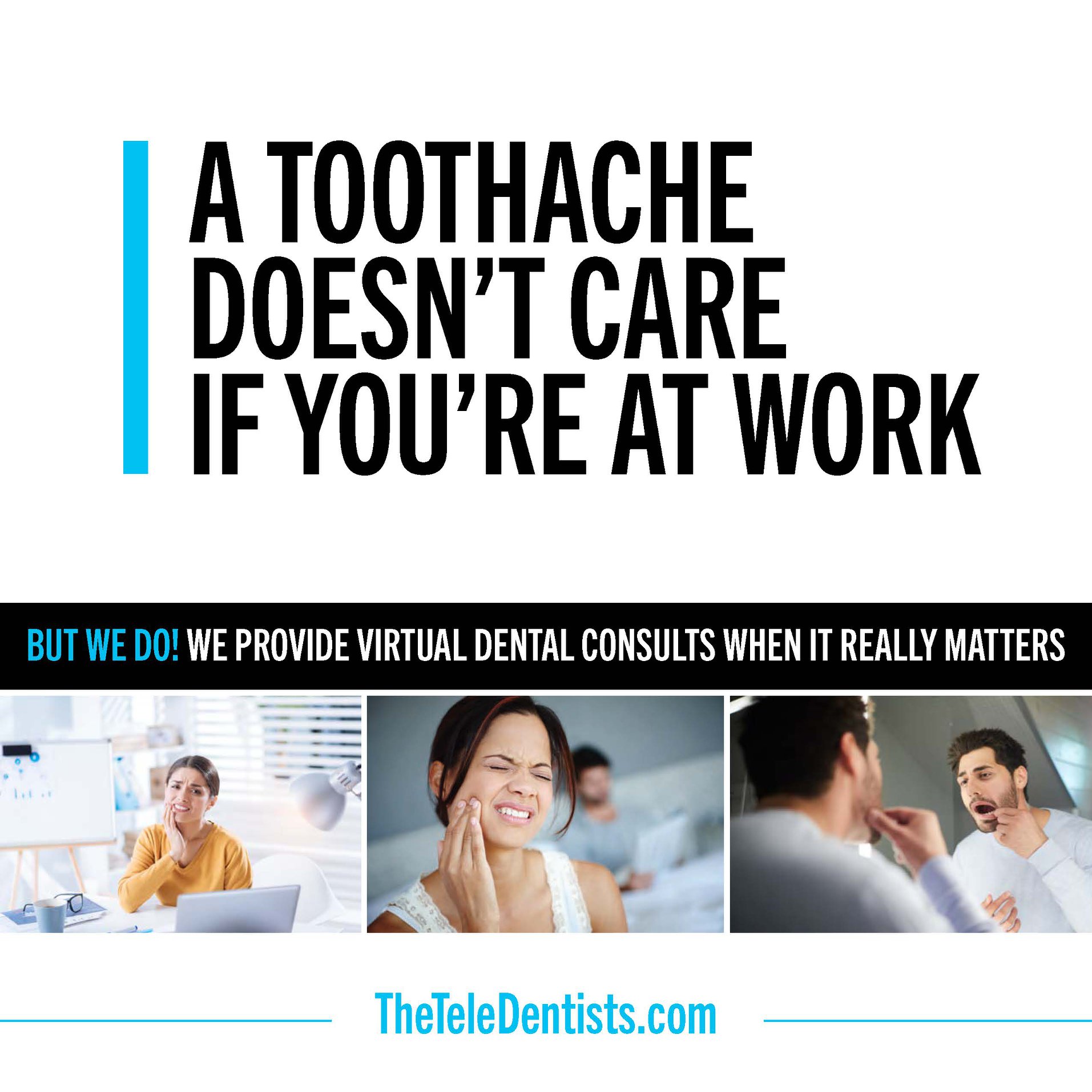
These challenges can create avoidable uncertainty, time away from work, and delays in connecting with appropriate dental care. A virtual consultation offers a convenient first point of contact when the situation is suitable for remote evaluation.
Teledentistry is most useful as an access and navigation layer within an existing occupational health program. It can support employees before an in-person appointment, after a dental visit, or when a regular dentist is unavailable.
During a virtual consultation, a licensed dentist may:
This approach can be especially valuable for employees who are on the job site, traveling for work, working remotely, or unable to reach a dental office during traditional hours.
An employee with new or worsening tooth pain may not know whether to leave immediately, wait until the next day, or seek medical attention. A virtual dentist can assess the reported symptoms, ask targeted questions, and provide a clear next-step recommendation.
The consultation may include guidance on temporary self-care, warning signs to monitor, and whether the employee should arrange same-day or follow-up dental care. It does not eliminate the need for treatment when the underlying issue requires a filling, extraction, root canal, or other procedure.
Falls, impacts, equipment incidents, and other workplace events can result in chipped, fractured, displaced, or knocked-out teeth. Occupational health and safety teams should always follow their established injury response, emergency, and reporting procedures first.
Once immediate medical and safety concerns have been addressed, a virtual dental consultation may provide additional dental triage and first-step guidance. The dentist can help determine whether the employee should be seen urgently by a general dentist, oral surgeon, endodontist, or another provider.
Teledentistry does not replace:
Those processes should remain with the employer, occupational health team, treating providers, insurers, and other responsible parties.
Gum swelling, facial swelling, persistent bleeding, or a suspected dental infection may require prompt attention. A virtual dentist can help evaluate the reported symptoms and identify red flags, such as fever, spreading swelling, or difficulty swallowing or breathing.
When those red flags are present, the employee should follow the dentist’s recommendation and the organization’s emergency protocol. A virtual consultation is an initial clinical service: not a substitute for emergency treatment.
Dental problems do not follow office hours. A 24/7 virtual service can help employees access professional guidance on nights, weekends, holidays, and during shift changes. This is particularly relevant for manufacturing, transportation, retail, hospitality, healthcare, public safety, and other industries with nontraditional schedules.

Occupational health nurses and clinic staff do not have to determine the dental diagnosis themselves. They can help the employee connect with a dental professional who can evaluate the concern and recommend an appropriate next step.
A clear care plan can help an employee understand what to do next, whether that means self-care, a prescription when appropriate, a dental appointment, or immediate medical evaluation. This can also help supervisors avoid making clinical judgments outside their role.
A virtual consultation can be completed from a private workplace location, home, or another appropriate setting with a phone, tablet, computer, or web connection. This may reduce unnecessary travel when the first step is consultation or triage.
Employers with multiple locations may not have a dental provider near every worksite. Virtual dental care can serve as a consistent access point while helping employees navigate local referrals when in-person treatment is required.
The TeleDentists wholesales its services to organizations including healthcare companies, payors, hospitals, emergency departments, urgent care organizations, retail businesses, and other partners. Business and employer solutions can be incorporated into an existing benefits, occupational health, or employee-support program.
A successful program does not require a complicated workflow. It does require clear expectations.
Decide whether the service will support:
If workplace injuries are included, define how the virtual service fits alongside: not in place of: existing injury reporting and emergency procedures.
A one-page protocol can identify:
The U.S. Department of Health and Human Services telehealth oral health guidance can also help teams think through appropriate use, privacy, technology, and clinical limitations.
Training should focus on recognizing common dental concerns, using the consultation platform, protecting employee privacy, and escalating potential medical emergencies. Staff should understand that they are facilitating access and following protocol: not diagnosing or determining whether a claim is compensable.
Employees should not have to search through a benefits portal while in pain. Provide clear instructions through onboarding materials, employee handbooks, intranet pages, QR codes, posters, and safety communications.
Explain when to use the service, how to connect, and what technology is required. The TeleDentists can be reached through a smartphone, tablet, computer, phone, or web platform, depending on the program configuration.

Virtual care is most effective when the employee has a path forward after the consultation. Determine how local referrals will be shared, who helps with care navigation, and how employees can reconnect if symptoms change.
The TeleDentists’ dental services include specialist referrals and treatment recommendations when a case requires in-person evaluation.
Occupational health programs are designed to help employees receive appropriate care while supporting safe, efficient operations. Dental concerns fit naturally into that mission, but they often fall between medical and dental systems.
Teledentistry helps close that gap. It gives employees a way to speak with a licensed dentist at the moment a question or concern arises. It gives occupational health teams a resource for dental triage and care navigation. And it gives employers a scalable option for supporting workers across different shifts, locations, and access environments.
The service is not a replacement for emergency protocols or hands-on dental treatment. It is a timely first step that can help employees understand the urgency of a concern and connect with the right level of care.
The TeleDentists provides 24/7 virtual dental consultations for dental injuries, sudden tooth pain, swelling, bleeding gums, pediatric concerns, treatment questions, and other oral health needs. Consultations are available through video, phone, mobile, and web platforms, with connection in under 10 minutes where supported.
Visit The TeleDentists to explore a workplace or occupational health partnership. You can also contact the team to discuss implementation, access pathways, and how virtual dental care can complement your existing employee health services.
URL slug: /teledentistry/occupational-health


